North America: +1 (833) 382 1008 »
Navigation

North America

+1 (833) 382 1008

Australia

+1 (800) 431 568

We talk to golf car dealers every week. And over the past two years, the same conversations keep coming up.

“We’re doing twice the volume we did in 2019, but it doesn’t feel like we’re making twice the money.”

“I’ve got three guys in the shop and I still can’t tell you exactly what our service department made last month.”

“We added LSVs and it’s great for business — but the admin is a lot.”

The golf car business has changed faster than most dealers expected. What worked five years ago — accounting software, spreadsheets, maybe a basic point-of-sale system — is starting to crack under the weight of custom builds, lithium conversions, commercial accounts, and growing LSV sales.

This isn’t a pitch. It’s what we’re seeing across hundreds of conversations with dealers navigating the same challenges, and what modern dealership software can actually solve. If you’re evaluating golf car dealership management software — or wondering if it’s time to — here’s what we think you should know.

→ See how Blackpurl works for golf car dealers

The Market Shifted. Did Your Systems?

It’s Not Just Golf Anymore

Ten years ago, most golf car dealers had a pretty straightforward business: sell carts to courses and retirement communities, service what you sell, move some parts and accessories.

That’s not the reality anymore.

Dealers tell us their customer mix now includes:

  • Neighborhood and lifestyle buyers using golf cars as daily drivers in planned communities, beach towns, and college campuses
  • Commercial and fleet accounts — resorts, warehouses, hospitals, industrial facilities — buying utility vehicles in quantity
  • Street-legal LSV buyers who want vehicles they can drive on local roads

The market is growing fast, and dealers positioned to capture that momentum are seeing real results. But growth creates complexity and complexity exposes the cracks in how you’re running the business.

Custom Builds Changed Everything

Here’s something we hear constantly: “I know we’re making money on custom builds. I just can’t tell you exactly how much.”

Walk through most successful golf car dealerships today and you’ll see rows of lifted, customized vehicles — aftermarket wheels, upgraded seats, premium audio, lithium battery swaps. The days of selling stock carts off the floor are fading fast.

We’ve heard from dealers who assumed they were making solid margin on custom builds — until they actually tracked the costs. Some discovered they were losing money on certain configurations because accessory costs, labor, and freight were scattered across spreadsheets and purchase orders that never got reconciled to the unit.

That’s not a technology problem. That’s a visibility problem. And it’s more common than most dealers realize.


Service Revenue Is Hiding in Plain Sight

“Service is a cost center.” We still hear dealers say this. But the numbers tell a different story.

Battery replacements, lithium conversions, seasonal maintenance, warranty work, fleet servicing contracts — these are recurring revenue streams that many dealers aren’t fully capturing.

The issue usually isn’t demand. It’s follow-through.

  • Service history lives in a filing cabinet or someone’s memory
  • Scheduling depends on sticky notes and callbacks that don’t happen
  • Technician time isn’t tracked accurately, so labor margin is a guess
  • Parts availability isn’t visible until someone walks to the back

We’ve seen dealers discover they were sitting on tens of thousands in unbilled warranty work simply because the paperwork wasn’t getting processed. That’s not unusual. It’s just usually invisible.

What Actually Matters in Golf Car Dealership Software

We’ve spent years working with golf car dealers — listening to what works, what doesn’t, and what they wish they’d known before choosing business software. Here’s what we’ve found actually moves the needle.

Easy to Use From Day One

The best software in the world doesn’t help if your team won’t use it.

We hear this from dealers who’ve been burned before: they invested in a system that was powerful on paper but so complicated that half the staff went back to spreadsheets within a month. Golf car dealership software should be intuitive enough that your team can be productive quickly — not after weeks of training or constant calls to support. If it feels harder than what you’re doing now, adoption won’t stick.

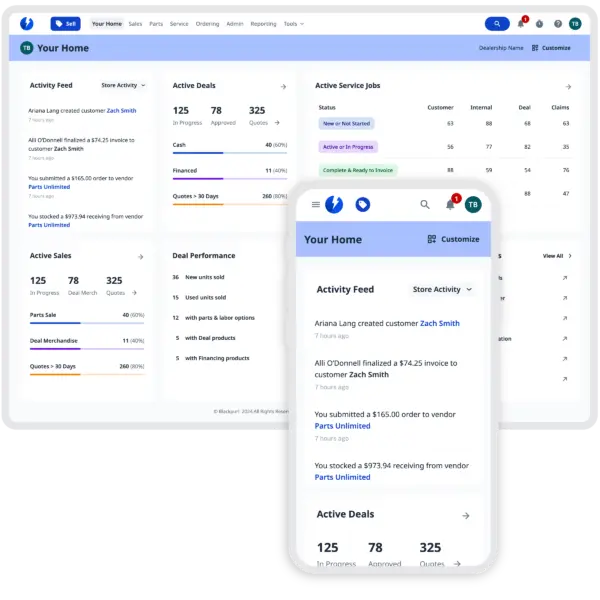
→ See how Blackpurl’s clean interface keeps teams productive from day one

Mobile Access That Actually Works

Golf car dealerships don’t operate from one desk. Your team is on the lot showing inventory, in the shop writing service, at the counter moving parts.

Software that only works from a desktop terminal creates bottlenecks. Your sales team shouldn’t have to walk back to the office to check if a unit is available. Your service writer shouldn’t have to leave a customer waiting to look up parts.

True mobile access means your team can work from a tablet or phone — on the lot, in the shop, or anywhere with an internet connection. That’s not a nice-to-have anymore. It’s how modern dealerships operate.

→ Learn how Blackpurl’s cloud-native platform works on any device

Connected Integrations That Eliminate Double-Entry

Here’s a pattern we see constantly: A dealer has accounting software for the books, a spreadsheet for inventory, a basic POS for parts, and paper work orders for service. Each piece works fine on its own. But nothing talks to anything else.

The result:

  • Sales doesn’t know a unit’s service history when evaluating a trade-in
  • Service can’t see what accessories were sold with a unit
  • Parts inventory is always slightly wrong because updates lag
  • Accounting spends hours reconciling data that should flow automatically

The biggest efficiency gains come from connected systems — where sales, service, parts, and accounting share the same data. When your DMS integrates with your accounting software, your website, and your payment processing, information flows instead of getting stuck.

No more double-entry. No more chasing down discrepancies. No more month-end scrambles.

→ Explore Blackpurl’s integration partners


One Place to Run Your Whole Operation

When everything lives in one system, your team stops wasting time switching between tools, re-entering data, and tracking down information that should be at their fingertips.

  • Quote a custom build and see accurate margin instantly
  • Check service history while you’re standing with a customer
  • Know what’s in stock across all locations in real time
  • Pull reports without exporting and combining spreadsheets

This isn’t about having the most features. It’s about having your business operations connected in a way that makes daily work easier.

→ See Blackpurl in action — book a demo
Questions We Get Asked Most Often


What’s the difference between Blackpurl 2 and regular automotive DMS?

Most automotive DMS platforms fall into two camps: enterprise systems built for franchise car dealerships with complex compliance requirements and multi-rooftop operations, or lightweight tools designed for used car lots that focus almost entirely on vehicle sales and financing.

Neither fits the golf car business.

Golf car dealers need something different: simpler workflows for accessory sales and custom builds, industry-specific price files, support for both retail and commercial accounts, and the flexibility to handle everything from a single golf car sale to a service job with multiple units. Blackpurl 2, a purpose-built golf car DMS, eliminates the complexity you don’t need while handling the specifics you do.

Does it work for dealers who sell LSVs too?

Yes. Whether you’re focused on traditional golf cars, LSVs, or a mix of both, the software should handle all of it without requiring workarounds. Blackpurl 2 is the system flexible enough to manage different vehicle types while keeping your operations streamlined.

How hard is it to get started?

For modern cloud-based platforms like Blackpurl 2, implementation typically takes about 30 days from kickoff to go-live. This includes moving your existing customer and inventory data, setting up your accounting integration, and training your team.

What if we’re currently using spreadsheets or basic software?

You’re not alone — most golf car dealers started there. The transition to a proper DMS is usually smoother than expected because you’re moving from scattered information to everything in one place. Dealers often tell us they wish they’d made the switch sooner.

Can our team actually use it on tablets and phones?

True mobile access means the full system works on a tablet or phone — not a stripped-down version with limited features. Your sales team should be able to quote a deal from the lot. Your service writer should be able to check parts without walking to a desktop.

blackpurl-home-1

Why We Built Blackpurl 2 for Golf Car Dealers

Everything above comes from real conversations with real dealers. And it’s why we built Blackpurl 2 the way we did.

Blackpurl 2 is the cloud-native dealership management platform built for golf car, powersports, trailer, RV, and equipment dealers. We work with golf car dealerships across North America, Australia, and New Zealand — from single-location operations to multi-store groups — helping them manage sales, service, parts, and accounting in one system.

We’re not the right fit for everyone. But if what you’ve read here sounds familiar, we’d love to show you how we handle it.

Explore Golf Car Solutions

More to explore