North America: +1 (833) 382 1008 »
Navigation

North America

+1 (833) 382 1008

Australia

+1 (800) 431 568
Blackpurl_blog

There’s an old lesson in business: a good owner never sees a customer as a single sale. They see every visit that customer might make over the next twenty years, and every friend they might send. They remember the small things about that customer’s life, because that memory is the business.

The same idea holds true for trailer dealers. Ronnie started in the trailer industry at 19 and built Happy Trailers into a multi-location, full-service trailer dealership group spanning Texas and Oklahoma, earning a reputation as a thoughtful leader and sharp operator in the field. I asked what he thought dealers should focus on going into the slow season. I expected an answer about inventory or advertising. Instead, nearly every answer came back to one idea.

“I think Customer Lifetime Value is one of the most important things for a trailer dealership to focus on.”

Ronnie explains it in operational terms: service intervals, follow-up calls, the service calendar, the F&I menu. Underneath, it’s a deeply human idea. This article connects the two, because they describe the same thing, and because the off-season is when it matters most.

The $8,000 trailer is the smallest number in the deal

Ronnie names the trap plainly.

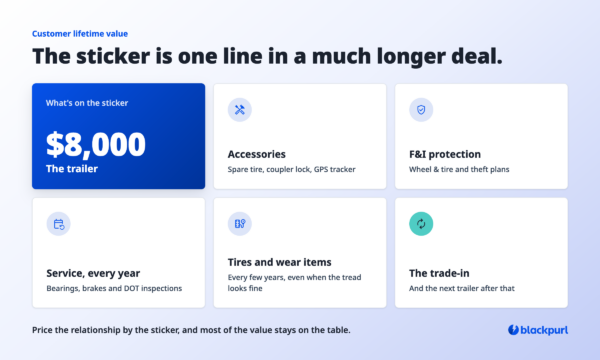
“The most obvious focus is to sell the $8,000 trailer, but in the process, it’s easy to look past the opportunity to sell higher margin accessories and F&I products at the time of sale.”

It’s an easy trap to fall into. The trailer is what’s on the lot, on the website, and in the customer’s first question. But the price on the sticker is only the first number in a much longer relationship. Every trailer that leaves the lot comes with years of bearings, brakes, tires, lights and wiring, the accessories that make it work for how the owner actually uses it, and eventually a trade-in. Ronnie describes this as a holistic approach: considering the lifetime value of the customer, not just the price of the trailer they’re buying.

When a dealer prices the relationship by the sticker, both sides lose. The dealer leaves most of the value on the table. The customer ends up piecing together their ownership from whoever is closest when something breaks, a tire shop here and a parts store there, and never quite feels looked after by anyone.

In-article · The sticker vs. the deal

What hostmanship looks like at a trailer dealership

There’s a word for the alternative: hostmanship, the art of making people feel genuinely looked after. It isn’t a process or a script. It’s caring whether the customer’s ownership goes well, and paying attention to the details that tell you what that person needs.

At a trailer dealership, hostmanship is a service advisor who remembers that this customer hauls cattle every spring. It’s a parts counter that knows they had a blowout two years ago. It’s a phone call before the customer realizes they need one.

The difference between hostmanship and selling isn’t the product. Often it’s the exact same spare tire, the same protection plan, the same coupler lock. The difference is the question behind the offer. Selling asks, “What else can I sell you?” Hostmanship asks, “What do you need for this to go well?” Customers can feel which question you’re asking, and they respond to it.

Start with their history, not your inventory

Ronnie’s answer to the accessories and F&I gap is to listen before offering anything.

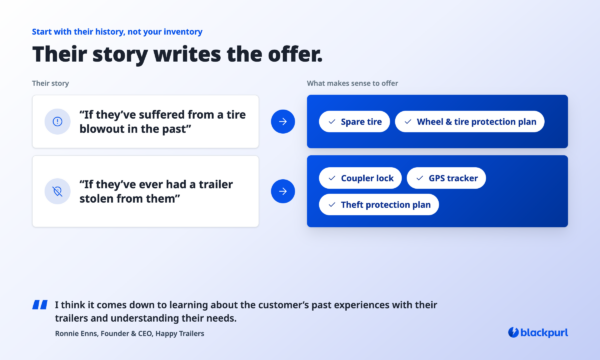
“I think it comes down to learning about the customer’s past experiences with their trailers and understanding their needs. If they’ve suffered from a tire blowout in the past, selling them a spare tire and a wheel & tire protection plan makes sense. If they’ve ever had a trailer stolen from them, it should be easy to sell them a coupler lock, GPS tracker, and a theft protection plan.”

This is the part of Ronnie’s thinking I find most compelling, because it dissolves the tension most salespeople feel. There’s nothing pushy about offering a wheel and tire protection plan to someone who has stood on the shoulder of a highway next to a shredded tire. There’s nothing pushy about a GPS tracker for someone who has walked out to an empty driveway. The offer follows from their story, so it sounds like care, because it is.

It’s also good business, and that isn’t a contradiction. Accessories and F&I products carry higher margins than the unit itself. When they’re sold because they solve a real problem, the dealer earns more, the customer is better protected, and neither one has to feel awkward about it. Customer-centric and profitable point in the same direction.

A few questions open the door: what’s gone wrong with a trailer you’ve owned before, what you’re hauling and how often, where it sits when you’re not using it, and how long you plan to keep it. The habit that turns a good conversation into hostmanship is writing the answers down. That way, the next person who talks to that customer, in sales, service or parts, at whichever location they walk into, already knows their story and doesn’t make them tell it again.

The trailer tells you when it will need you

The second half of Ronnie’s idea is where his operational knowledge really shows. Customer lifetime value sounds abstract until you realize the trailer industry has already published most of the calendar.

“Using the service interval recommendations published by the axle manufacturers and estimating the useful life of the trailer can help predict how often the customer could come back for maintenance and when they might be ready to trade in.”

The intervals are right there. Most axle manufacturers call for bearing and brake service roughly once a year. Tire makers generally recommend replacing trailer tires every few years, even if the tread looks fine. Commercial customers also face a required annual inspection.

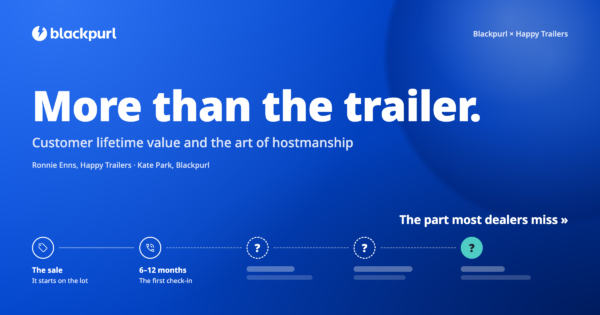
Lay those intervals over one ownership and the shape of the relationship appears. At the sale, there’s the trailer plus the accessories and protection that fit how the customer lives with it. Soon after comes the first check-in, which Ronnie builds in deliberately: “After the sale, a 6 month or 12 month follow up is a good idea to check for any service and maintenance needs.” Every year after that, there’s bearing and brake service, plus the DOT inspection if they’re commercial. Every few years, there are tires and wear items. And at the end, there’s the trade-in and the next trailer.

Put simply, it’s anticipating what someone will need before they ask. Ronnie calls it predicting when the customer could come back. It’s the same skill, and it’s what makes a customer feel looked after rather than sold to.

The off-season is where the relationship is earned

All of this matters most when selling slows down.

“With the off-season approaching, trailer owners are less likely to be shopping for a new trailer, and more likely to be interested in getting maintenance and repairs done in preparation for next year.”

It’s tempting to treat the slow months as a pause between selling seasons. I’d argue they’re the most important part of the relationship, because they’re when you show a customer you care about them while they aren’t making a big purchase. Ronnie’s advice is direct:

“Being proactive with calling your customer list and scheduling winter maintenance is a great way to boost parts sales and keep your shop booked during the slow selling season.”

The call list is already in the dealer’s system. Start with customers whose last bearing service was a year or more ago, trailers three or more years old that are due a tire conversation, commercial customers with an annual inspection coming up, anyone with an open recall or warranty item, and recent buyers due for their six- or twelve-month check-in. Then make the reason for the call about their trailer, not your schedule. “We have openings in January” is about the dealer. “Your bearings are coming up on their twelve-month service, and we’d rather help you take care of it now than have you freak out later.” is about the customer.

Hostmanship includes your own team

A full calendar only works if the people behind it can deliver, and Ronnie builds his schedule around exactly that.

“I ask our service advisors to schedule all service appointments in the service calendar of our DMS. Customers are more likely to be willing to schedule off-season maintenance further in advance, so that we’re able to keep a full schedule that is still within the capacity of our staff.”

The last part of that is easy to read past: a full schedule that is still within the capacity of the staff. Hostmanship isn’t only how you treat customers. It’s also how you treat the people who look after them. A technician booked far past capacity can’t look after anyone; they can only get through the week. Technician shortage has been flagged as a major operational and financial issue for dealers, which makes looking after the techs you have more important than ever.

In practice, that means booking by tech hours rather than by number of trailers, because a bearing repack and a full brake job are not the same slot. It means keeping a short list of indoor work, like used unit recon and accessory installs, for quiet days. And it means using the slow season to invest in your people. 
Making it stick: from a sales habit to a service culture

Everything in this article is easy to agree with. The hard part is Monday morning. A shift like this rarely takes hold because of a memo or a new policy. It takes hold when the people doing the work understand why it matters, see their leaders doing it, and get a few small wins early.

So start small. Ask one history question at every sale, and write the answer on the customer record. Put the six- or twelve-month follow-up on the calendar the day the trailer leaves the lot, in the same shared service calendar Ronnie’s advisors use for every appointment. Talk about returning customers in the weekly meeting, not only units sold. And recognize the service advisor whose call saved a customer from a blowout as loudly as the salesperson who closed a big deal. What a team celebrates is what it becomes.

Measure what you value, too. A dealership that only tracks units sold will keep optimizing for the sale. Track how many customers come back for service, how many deals include protection or accessories that fit the customer’s story, and how many trade-ins come through your own service drive. Those numbers tell you whether the relationship is working.

The loop closes in the service drive

This is where everything above pays off, and Ronnie puts it plainly.

“Providing for all the needs of the customer throughout their trailer ownership ensures they’ll be back to trade their trailer in at your dealership for a new one when the time comes.”

The trade-in conversation doesn’t start when the customer is ready to buy. It starts years earlier, in the service drive, with whoever answered the phone when the brakes went. When a repair estimate comes back at a number that makes a customer pause, that’s a natural moment to ask whether they’d like to know what their trailer is worth in trade before they decide. And when a customer mentions in service that they’re outgrowing their trailer, that note belongs on the repair order and in front of sales the same day.

A customer who has been looked after well for years doesn’t shop around for their next trailer. They come home.

In-article · Their story writes the offer

The takeaway

Ronnie’s insight is operational: follow the service intervals, follow up after the sale, listen before you offer, and keep the calendar full but fair. The human insight underneath it is simple: people return to the places that remember them. Put side by side, they’re the same insight in two different languages.

Sell someone a trailer and you have a customer for a day. Look after them for the life of that trailer and you have a customer for the next one, and very likely the one after that.

Whatever system a dealership runs on should make this kind of hostmanship easier, not harder. 

About the authors:

Ronnie Enns is the founder and CEO of Happy Trailers, a multi-location, full-service trailer dealership group. He started in the trailer industry at 19 and opened Happy Trailers as a single location, doing everything from hauling trailers to sales and service. Today he focuses on team health, organizational clarity and an elevated customer experience, and he has served on the NATM Dealer Committee and the NATDA Dealer Advisory Council as a dealer voice in conversations moving the industry forward.

Kate Park is Marketing Manager at Blackpurl, the company behind Blackpurl 2, a modern, next-gen dealership management software for trailer, RV, powersports, golf car and equipment dealers across North America, Australia and New Zealand. Her work sits where technology and people meet, helping dealers adopt better ways of working that move their businesses forward, smarter and more efficiently. 


More to explore

Oct. 5, 2026

A street-legal cart is a low-speed vehicle, and the law treats it like a car. Here are the six paperwork gaps that catch golf car dealers at the point of sale, what they cost, and what your DMS should be doing about it.